Wine Storage Repair
Can a Sub-Zero Wine Cooler Work as a Fridge? What to Check
Copy by Rosalind Okafor Refrigeration technician — dual-refrigeration and column units · 22 years in the trade
Treats a dual-refrigeration cabinet as two machines that happen to share a door line, and diagnoses the halves separately. The evaporator that frosts and the one that never does are rarely failing for the same reason.
EPA 608 certified
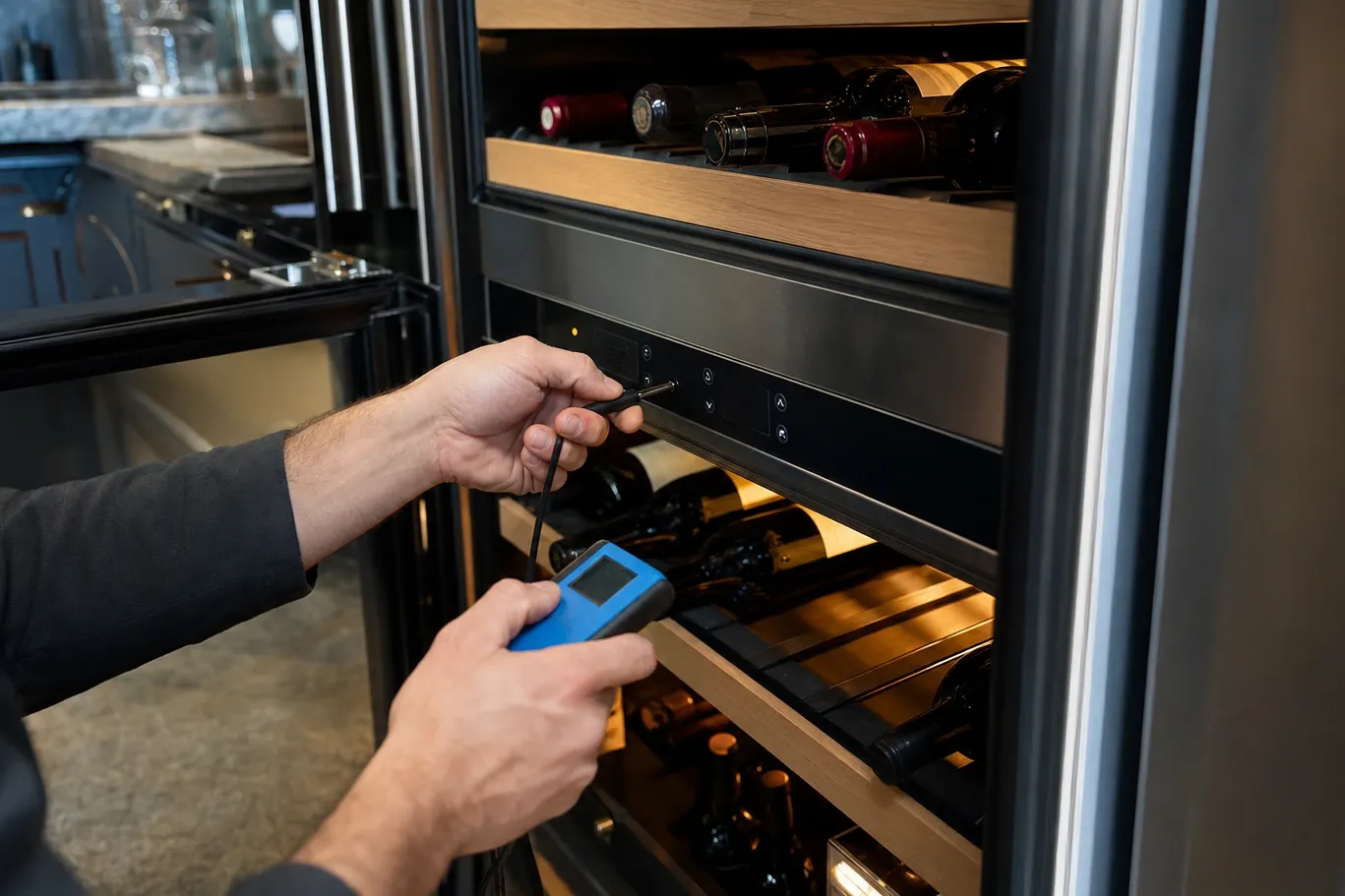
A wine cooler can keep drinks cold, but it should not stand in for a refrigerator. Most wine units bottom out around 40°F, and perishable food needs to stay at 40°F or colder all the time, so milk, raw meat and leftovers would sit right on the line and drift above it every time the door opened. Sub-Zero’s own numbers show the gap: its Designer Undercounter wine storage sets between 40°F and 65°F, while the matching undercounter refrigerator runs 34°F to 42°F. The temptation is strongest in a Streeterville condo bar with no second fridge, which is exactly where a wrong guess spoils the most food.
Wine cold and food cold are two different jobs
A refrigerator is built to pull warm groceries down quickly and hold them in the mid-30s through dozens of door openings a day. A wine cabinet has the opposite temperament: slow, gentle cooling, steady humidity so corks stay supple, and little vibration. It is sized for bottles that rest for months, not for a gallon of milk and a pack of chicken thighs.
Sub-Zero’s Designer Undercounter (DEU) family shows how the settings split by purpose:
| DEU version | Temperature setting window |
|---|---|
| Wine storage | 40°F to 65°F |
| Beverage center | 34°F to 55°F |
| Refrigerator | 34°F to 42°F |
| Freezer | -5°F to 5°F |
The beverage center can reach true refrigerator temperatures, which makes it the nearest thing to a fridge in a glass-front cabinet. The wine version cannot. Even the 24-inch DEU2450W, which has two wine zones, keeps both of them inside the wine window, so neither half becomes a food compartment.
Cheap thermoelectric coolers add a further limit: with no compressor, they only cool so many degrees below the room, so in a warm July kitchen their coldest setting is more hope than number.
What a wine cooler can hold instead
Drinks are where a wine cooler earns its space beyond wine. Sealed beer, sparkling water and soda are fine at 40°F to 50°F, and moving them out frees kitchen shelves for food.
A few things sit in a gray zone. Chocolate and wrapped hard cheese tolerate wine temperatures for short stretches. Dairy, deli meat, cut fruit and leftovers do not belong there beyond a party’s worth of hours, and even then only with the dial at its coldest.
Some owners keep cigars. Certain Sub-Zero Designer Wine (IW) units accept a Sub-Zero humidor, and once one is fitted the control flashes a reminder roughly every 2 months, when the door opens, to replace the humidity packet; touching snooze pushes it back 2 weeks. The IW-18 and IW-24 cannot take the humidor, so confirm the model first.
Read the tag before you buy a wine unit
Whether you are looking at a used Sub-Zero wine column, a showroom piece, or a Gold Coast condo that comes with one built in, start with the serial tag. Sub-Zero’s manuals call it the rating plate, and besides the model and serial numbers it records when the unit was built, which refrigerant it uses and how much, and its total amps. On DEU undercounter units it is on the cabinet ceiling; on other models, open the door and look along the inside walls.
The model number says what the unit was built to do. It begins with letters for the product line, then digits for the width, then letters for features such as panel type and door style. On wine models you will mostly meet these prefixes:
- BW marks Legacy Classic wine storage, from the line once called Built-In.
- IW marks Legacy Designer wine storage, from the line once called Integrated.
- DEU is Designer Undercounter, sold as wine, beverage, refrigerator and freezer versions.
The old names still turn up in listings and manuals: in March 2019 Sub-Zero renamed the Built-In series as Classic and the Integrated series as Designer.
A former store display carries its own warranty terms. Display products sold three to seven years after the original manufacturer invoice date get a full one-year warranty plus a limited five-year sealed system warranty, and a copy of a paid invoice is needed to switch it on. Ask for that paper before any money moves.
One more tell on a seller’s notes: a record of water filter changes for the wine unit. Sub-Zero wine storage has no internal water filter, the IW-30CI being the single exception, so that history probably belongs to a different appliance.
Condition checks worth an afternoon
Run the unit for a full day at its coldest setting with a thermometer standing in a glass of water on a middle shelf; water shows the settled temperature, not the air’s quick swing at each door opening.
Then work through the rest:
- Read the display. On Classic wine storage (BW), EC 05 and EC 07 flag the upper or lower cabinet thermistor, and EC 06 and EC 08 the upper or lower evaporator thermistor; all four need a technician. On a Designer Wine (IW) unit, 40 1 09 means zone 1 is far too warm or too cold. Sub-Zero’s advice is to kill the breaker for 30 seconds and book service if the code returns. A 95 1 00 only says the zone 1 door sat open for 20 minutes or more, so clear whatever propped it, reset the breaker the same way, and carry on if nothing else appears.
- Test the seal. Shut the door on a dollar bill at several points. If it slides out with no drag, the gasket is tired, and a tired gasket is a frequent cause of fogged glass; our piece on wine cabinet glass sweating in a humid August goes deeper.
- Listen. A soft hum and an occasional fan whir are normal. Grinding, rattling or a ticking fan blade are not.
- Look underneath. Water on the floor usually traces to a blocked drain or an overflowing pan rather than refrigerant, but get it explained before you pay.
Placement in a Chicago home deserves its own check. On one Sub-Zero wine line, the warm alarms EC 10 for the upper cabinet and EC 12 for the lower start with confirming the surrounding air never dips under 60°F (16°C) or climbs past 90°F (32°C). An enclosed back porch on a two-flat or an unheated garage drops well under that in January, and a wine unit parked there will look faulty when the real problem is the room.
What repairs cost when a check turns something up
The price depends mostly on which part has failed. These are typical bands for Sub-Zero refrigeration work around Lincoln Park, Lakeview East and the lakefront, and the firm figure follows a technician’s diagnosis:
- A new door gasket: $290–$650
- A replacement evaporator or condenser fan motor: $320–$710
- A new electronic control board: $410–$990
- Sealed-system work, compressor included: $1,460–$3,360
Our visit is a flat $89 for the trip and the complete diagnosis, and that sum comes off the repair bill once you give the go-ahead. If you still need food storage near the bar, buy an undercounter refrigerator rather than running a wine cabinet at its floor. Our wine storage repair page lists the faults we meet most often, and refrigerator repair covers the food side. To have a wine unit looked over before you sign, ring (312) 964-8834.
Follow-up questions
- Does a wine cooler get as cold as a refrigerator?
- Usually not: most wine coolers stop around 40°F at their coldest, while a kitchen refrigerator holds food in the mid-30s. On Sub-Zero's Designer Undercounter line the wine version sets from 40°F to 65°F and the refrigerator version from 34°F to 42°F, so the wine unit only touches the warm end of fridge territory.
- Can you keep milk in a wine fridge?
- Only for an afternoon, and only with the cooler turned to its lowest number. Milk wants steady cold at 40°F or below, and a wine cabinet sitting at its floor has nothing in reserve once guests start opening the door. Overnight, put dairy back in the kitchen refrigerator.
- Can I convert my wine cooler into a refrigerator?
- No, there is no safe conversion, because the lowest setpoint is locked into the control and the cooling system is sized for still bottles rather than warm groceries. Tricking a sensor to push it colder tends to ice the evaporator or keep the compressor running nonstop.