Refrigerator Repair
Does a Sub-Zero Really Keep Food Fresher, and for How Many Years?
Copy by Rosalind Okafor Refrigeration technician — dual-refrigeration and column units · 22 years in the trade
Treats a dual-refrigeration cabinet as two machines that happen to share a door line, and diagnoses the halves separately. The evaporator that frosts and the one that never does are rarely failing for the same reason.
EPA 608 certified
Yes, but only while the machine is healthy. A Sub-Zero holds food longer than an ordinary freestanding fridge mainly because it keeps the fresh-food air apart from the freezer air and holds its temperature in a narrow band, so produce keeps its moisture and leftovers do not pick up freezer smells. Nothing about the badge stops food from ageing, though, and the advantage shrinks as the refrigerator itself gets older. In a Gold Coast condo or a Lincoln Park two-flat where the unit has been built into the cabinetry for decades, that slow fade is usually why the berries are going soft a day early.
Where the freshness advantage comes from
Three things do most of the work, and none of them is magic.
- Separate air for each section. Sub-Zero’s dual refrigeration keeps the freezer’s very dry, very cold air out of the fresh-food compartment. A single-system fridge borrows freezer air to chill the fresh side, and that air pulls moisture out of lettuce, herbs and cut fruit. Keeping the two apart lets the refrigerator side stay humid and stops your ice from tasting of last night’s curry.
- A temperature that barely moves. Food breaks down faster when it warms and chills over and over. A built-in that cycles gently behind good door seals keeps those swings small.
- Cleaner air, on models that take a cartridge. Some units carry an air purification cartridge meant to cut odors and the ethylene gas that ripening fruit releases. It only helps if it gets changed, and it is a running cost: the warranty covers neither replacement cartridges nor replacement water filters.
What the refrigerator will not do is stretch a use-by date, rescue groceries that went in tired, or make up for a door opened forty times over a busy holiday weekend.
Signs the edge is slipping
Owners rarely see a Sub-Zero fail all at once. They see food behaving differently. Watch for:
- Salad greens wilting within a couple of days, or freezing against the back wall
- Beads of moisture on the shelves or around the gasket
- The compressor running almost without pause, with warm cabinet sides or a warm grille
- Frost that rebuilds in the freezer soon after you clear it
- The fresh-food side drifting warm while the freezer stays rock hard
That last pattern surprises people, but it fits the design. Because each compartment has its own cooling, a fan, defrost part or sensor on the refrigerator side can quit while the freezer carries on normally. If the fridge is warm and the freezer is fine, clean the condenser, check the door seal and give it a day. If it has not recovered by then, book a refrigerator repair visit before the milk turns.
How long a Sub-Zero keeps running
Long, by appliance standards, and the company’s own production timelines show how far back the units still in Chicago kitchens can reach. The 500 Series was built from 1987 to 2003, which makes any survivor at least 23 years old and an early one close to forty. The 600 Series ran from 1996 to 2009. The first 700 Series models, the 700BR among them, entered production in 1994. More recently, the Legacy Classic BI built-ins were made from 2008 to 2022 before the current Classic CL series took over, and the Designer IT and IC tall and column models were built from 2014 to 2022.
Your unit’s exact age is printed on its serial tag, and knowing it changes the conversation. A seven-year-old refrigerator with a weak seal needs a simple repair. A 600 Series with a weak seal, a noisy fan and a laboring compressor is telling you something about its whole life.
The warranty hints at which parts are expected to last. Sub-Zero gives a full two years on parts and labor from installation, a full five years on the sealed system (compressor, condenser, evaporator, drier and tubing), and a limited twelve-year sealed system warranty under which it supplies the part while you pay for the labor.
What wears a Sub-Zero out early in Chicago
Most premature wear traces back to heat the unit cannot get rid of. The condenser is where that heat leaves, and Sub-Zero advises cleaning it every six to twelve months, more often with a dog or cat in the house. On a Classic CL it sits behind the flip-up grille; on the current Designer DET and DEC models it hides behind the kickplate, which comes off with two screws. Power it down from the control panel first, then, wearing gloves, run a vacuum fitted with a soft brush attachment along the fins rather than across them, so the thin aluminum stays straight. Skip the spray-on condenser cleaners, which Sub-Zero calls unnecessary and does not recommend.
Chicago adds its own strain. A hot, sticky July pushes a condenser hard, especially in a Streeterville high-rise kitchen where the refrigerator is boxed into millwork and the grille is its only route for air. In winter, older two-flats and courtyard buildings heated by radiators bring the opposite problem when a radiator sits close to the cabinet’s side panel.
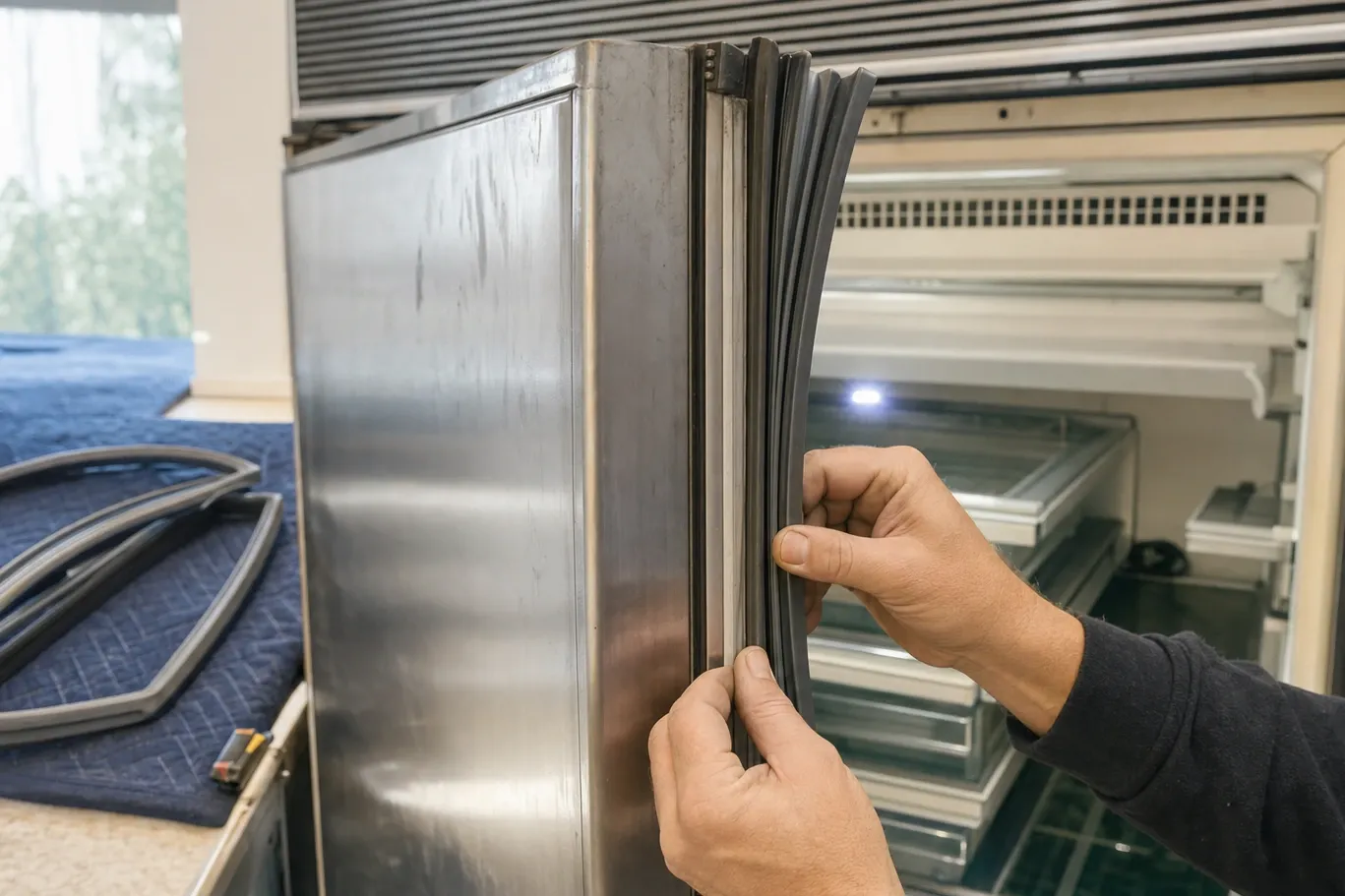
Door gaskets are the other quiet culprit. A seal that no longer grips lets humid kitchen air in, the compressor runs longer to make up for it, and frost and condensation follow. A dollar bill makes a handy gauge: close the door on it in a dozen spots around the frame, and wherever it slides out with no tug the gasket has let go.
Age or one bad part? Doing the math
A single failed component on an otherwise sound unit is almost always worth fixing. These are typical ranges in our area, with a firm quote once the fault is diagnosed:
| Repair | Typical range |
|---|---|
| New door gasket | $290–$650 |
| Evaporator or condenser fan motor | $320–$710 |
| Defrost heater, thermostat or sensor | $270–$670 |
| Electronic control board | $410–$990 |
| Compressor or sealed-system repair | $1,460–$3,360 |
A comparable new built-in costs $12,430–$21,780, so even sealed-system work usually comes to a fraction of replacement.
Age becomes the real problem when faults start stacking: a second or third repair inside a short stretch, rust on the cabinet or cracked liners, a sealed system failing years after the twelve-year coverage has run out, or parts for an older series that have become slow to source. By then the freshness you bought the refrigerator for is the first thing to go, and the repair bills keep arriving anyway. Our $89 service call covers the trip and a complete diagnosis and is credited toward the work once you say yes, so finding out where your unit stands costs the same whichever way you decide. Call (312) 964-8834 to get the numbers before you choose.
Follow-up questions
- Does a Sub-Zero really keep produce fresher than a standard fridge?
- It can, as long as the unit is running properly. Keeping freezer air out of the fresh-food side holds humidity in, so greens and herbs wilt more slowly, and a steady temperature slows spoilage. A dusty condenser or a tired door seal erases much of that difference.
- Why is my Sub-Zero refrigerator warm when the freezer is still cold?
- Because each section has its own cooling, a fault on the fresh-food side can leave the freezer untouched. Typical culprits are a failed fan, a defrost problem or a bad sensor. Clean the condenser, check the door seal and allow a day to recover; if it stays warm, have it diagnosed before food is lost.
- How much does a Sub-Zero repair usually cost?
- It depends on the part: a door seal typically runs $290–$650, a control board $410–$990 and sealed-system work $1,460–$3,360, with a firm quote after diagnosis. The visit and full diagnosis come to a flat $89, which is then knocked off the repair bill if you go ahead with the work.
- How can I find out how old my Sub-Zero is?
- Check the serial tag, which carries the manufacture date. For a warranty claim, Sub-Zero also asks for the model and serial number off the rating plate, when the refrigerator went in, and which dealer supplied it.
- Does the warranty cover a compressor that fails after ten years?
- Partly: through year twelve, Sub-Zero still supplies the faulty sealed-system part, but not the labor to fit it. That limited coverage takes in the compressor, condenser, evaporator, drier and the tubing joining them, while you pay for everything else. Parts and labor are both included only inside the first five years, under the full sealed system warranty.